“Will You Marry Me?” Examining Nature and English Romanticism through WWII Love Letters

Chris Barker and Bessie Moore first met while attending a training course for the Postal Office in southeast London. Upon completion of the course, they had developed a chaste relationship and began drafting letters to one another discussing politics and their hopes and dreams for the future. With World War II already occurring for three years, Chris became a soldier with the Royal Corps of Signals and was deployed to Libya. A year later, Chris decided to mail a letter communicating his love and feelings for Bessie, who at the time was seeing another man. The letter was received enthusiastically by her, and she spent many weeks writing a response which would change the trajectory of their lives forever. Their love letters spanned the next three years and more than 500 survived, capturing Chris’ unrelenting romance for Bessie. The letters eventually led to their marriage which lasted 58 years. Many of Chris’ letters contain references to different flowers. In the “My Dear Bessie Letters”, Chris uses nature through the Romantic ideas of William Wordsworth to equate his love for Bessie. 

The Romantic period began in the late 18th century as a response to the social and political norms of the Age of Enlightenment and as a reaction to the Industrial Revolution. The period brought profound change to the European world through literature, arts, and thought. Prominent English poets like William Wordsworth, Samuel Coleridge, William Blake, and John Keats appropriated poetry as the highest form of art and contributed to the Romantic movement through their writings. Their work shares mutual values, such as the emphasis on emotion and the exaltation of nature. For Wordsworth in particular, nature “was a saving process and a benign Presence” (Bloom and Trilling 7). This outlook on nature coined him the nickname of the “nature poet”. 
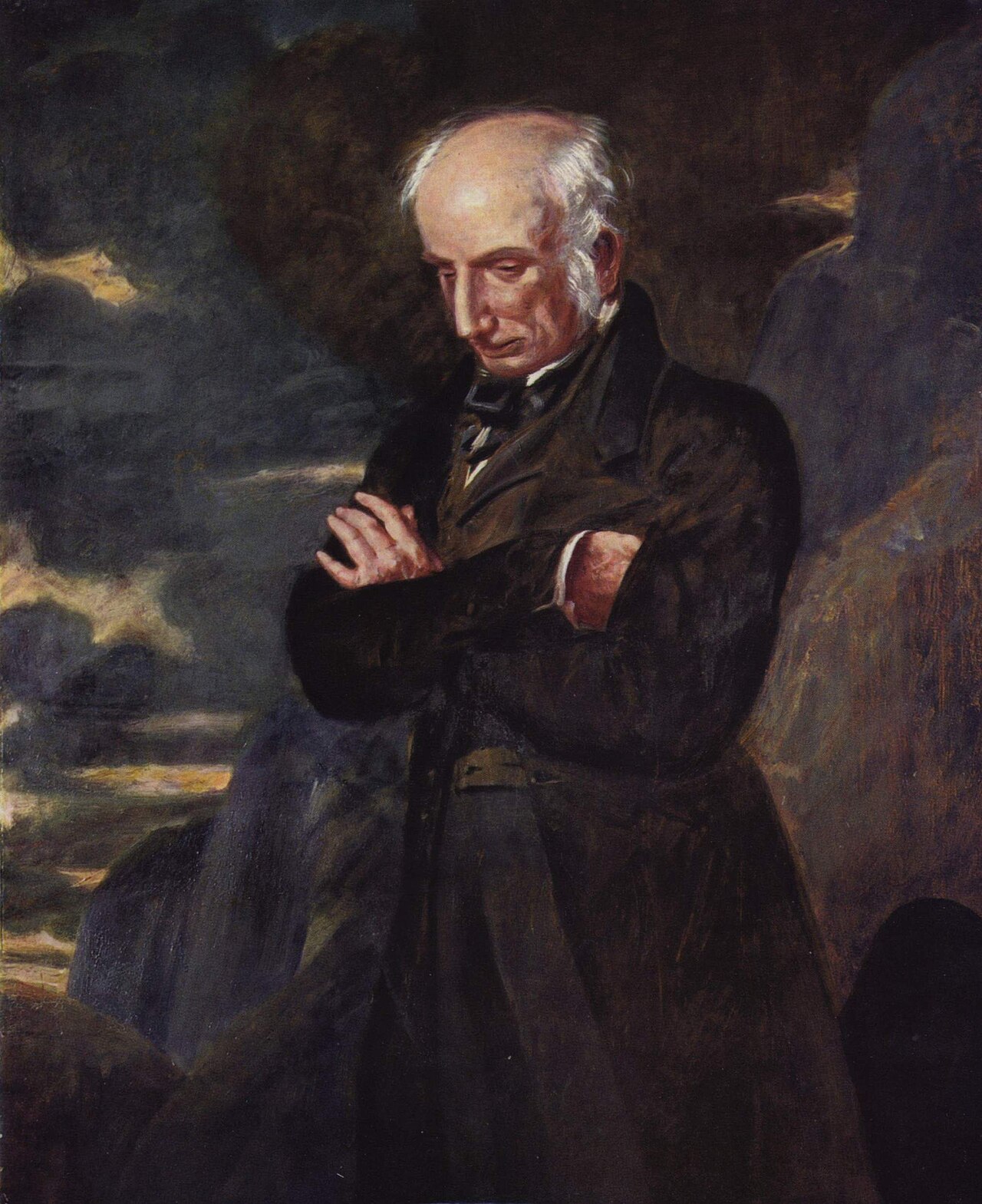
William Wordsworth, the “nature poet”. Credit: National Portrait Gallery

Firstly, Chris uses nature to connect with Bessie’s beauty and love tangibly. He sees nature as a relatable concept for making comparisons as it always surrounds us. In a letter written in June 1944, Chris uses figurative language to describe her letters. He says that “these letters of yours are just like an English river running through green fields, clear, refreshing, bright, confident. You come rippling down at me, surround me with your beauty and your meaning…” (64). Just like the English river that gives life as it flows through the pastoral landscape, Bessie rejuvenates Chris with love through nature’s beauty and her correspondences. He yearns to be enveloped by her natural presence and uses nature metaphors to substitute her void. We see another example of figurative language in a May 1944 letter, where Chris desires to see Bessie “…in puris naturalibus…to forage around you, to rove over you, to subdue due you, to possess you” (57). Chris uses language of natural possession such as ‘forage’ to secure his love for her in his war-torn environment. 

Like Chris’ comparison of Bessie to nature’s beauty, William Wordsworth writes in his Preface to Lyrical Ballads that “he considers man and nature as essentially adapted to each other, and the mind of man as naturally the mirror of the fairest and most interesting qualities of nature” (Reidhead and Johnson 301). He argues that human beings and the natural world are not separate. We are a part of it, and it is a part of us. It is through this connection to nature that Chris’ love for Bessie transcends borders and oceans regardless of their locale’s geography. In Chris’ eyes, the love he finds in Bessie’s letters is the missing puzzle piece that makes living sustainable.  

Through this connection with nature, Chris begins to imagine an alternative reality where he begins to subject himself to Bessie. Chris almost wants to fall slave to her. In a letter composed in April 1944, Chris states, “I am your servant and your master at once” (46). Perhaps this means that as a master he is taking charge of their love story but as a servant to Bessie, he views her as a force of nature rather than an object. The power and force Bessie emits from these letters blind Chris from the surrounding environment and bind him to her love. He longs to be consumed by her love letters. Like Chris, Wordsworth views nature as a power and not an object. He believes that nature “shaped his powers of mind and supplied his life” (Blunden 74). Chris continues writing to Bessie stating, “I will command you and be commanded by you”, reaffirming his desire to control the narrative with a different storyline as well as his subservience to her (47). Seeing Bessie this way provides Chris with a sense of grace and responsibility; it is dependent upon him to write so she will respond and comfort. 

Chris also uses his imagination as a mode of escapism. This distracts him from the present and offers opportunities to question the future. We see this in a letter from April 1944 where he writes, “…tell me of your clothes. Tell me your room, the furniture, so that I can better imagine you, more easily come to you when you are alone” (52). Asking these questions anchors Chris to a possible reality when there is no war, and he is reunited with Bessie. He demands every possible detail to attain a well-rounded image of his future wife. Similarly, Wordsworth epitomizes this escapist behavior. He would often depart commercialized areas overtaken by the Industrial Revolution for the Lake District to “relieve himself, not so much of himself, as of those exterior circumstances which aggravate and disturb him” (Jochem 18). Surrounding himself in nature would cure his personal struggles and allow him to be closer to his true love: nature. Furthermore, Bessie’s letters aid Chris in envisioning a better future and her descriptions construct a direct portal to her heart. 

Chris also uses nature as imagination to deem his relationship with Bessie as fantastical. He tries to cope with his love pragmatically by writing poetic letters but resorts to writing sexually explicit letters. This propels his imagination and fantasies to bloom. In a letter written in March 1944, he describes his fantasies saying, “This is a fever that I have which makes me hot and dispossesses my mental faculties whenever I think of you, which is more and more often” (32). One month later he writes, “how impossible to sleep with thought and wonder of you hot within me” (41)! Whenever Chris thinks of her, he is overcome by an “irrational, illogical, nonsensical” love fever where he places Bessie on a pedestal, just as Wordsworth elevates nature (32). Moreover, Wordsworth characterizes poetry in his Preface to Lyrical Ballads as “the spontaneous overflow of powerful feelings”, comparing love to the natural fantasy of life (303). With every passing letter that he writes, Chris’ fantasy world expands. He begins to lust over her femininity and becomes infatuated with her body. Responding to these feelings, he writes, “as I toss and turn and wriggle and writhe I think of you, probably doing the same…I know that if I think of you, I will not sleep; yet I keep on thinking of you, and get hotter and hotter” (41). Chris’ dreamlike hallucinations show us his love for Bessie is fantastical. Because of the war, his hormones are bottled up and these letters give him a fantastical outlet to release. Writing letters to Bessie where Chris describes her image, releases his sexual desires, fueling his connection with her.  

These examples teach us that Chris uses nature through the Romantic ideas of William Wordsworth to equate his love for Bessie. We learn that Chris uses nature to connect with Bessie’s beauty. He uses figurative language to take the place of void and language of natural possession to secure his love for her. Additionally, Wordsworth argues that human beings and the natural world are not separate. Through this connection with nature, we learn that Chris uses his imagination three separate ways. Firstly, he creates an alternative reality where he subjects himself to Bessie. He views her as not an object but a power, which she releases from her letters to secure Chris. Bessie’s letters give Chris a sense of grace. Wordsworth agrees with this idea and believes the power of nature gave him intellect. Secondly, Chris uses imagination as a mode of escapism to distract himself from the present so he can ponder his future. He sends letters demanding her every detail to attain a clear image of his future wife. The details he receives in her letters aid Chris in visualizing a different future. Lastly, Chris uses imagination to create a fantastical relationship with Bessie. He places her on a pedestal in response to the love fever he gets when thinking of her. In comparison, Wordsworth likens love to the natural fantasy of life. Moreover, letters describing Bessie’s image give Chris comfort and propel him to lust over her and release his sexual desires.

Works Cited

Barker, Chris, and Bessie Moore. My Dear Bessie: A Love Story in Letters. Edited by Simon Garfield, Canongate, 2015.

Bloom, Harold, and Lionel Trilling. Romantic Poetry and Prose. Oxford University Press, 1973.

Blunden, Edmund. Nature in English Literature. Harcourt, Brace, 1929.

Haydon, Benjamin. William Wordsworth: A Life. 1989. National Portrait Gallery, London. Wikipedia.org. https://en.wikipedia.org/wiki/William_Wordsworth#/media/File:Wordsworth_on_Helvellyn_by_Benjamin_Robert_Haydon.jpg. Accessed 17 Oct 2023.

Jochem, Anita Marie. “Escapist Tendencies as Evidenced in the Poetry of the Romantic Poets: Wordsworth, Coleridge, Shelley, Keats and Byron.” Master’s Theses, Loyola University Chicago, 1941, Accessed 13 Oct. 2023. 

Reidhead, Julia, and Marian Johnson, editors. The Norton Anthology of English Literature. 10th ed., W.W. Norton & Company, 2018. 

Welcome to my Ted Talk!

Our Presentations

This past week we completed our study unit on World War II letter writing with our presentations which accompany our papers. It was very interesting to listen to many of the presentations and take note of the various public speaking techniques that were being used. I was especially impressed with the visual aids incorporated into the presentations and how each aesthetic differed from the next. One such presentation I found compelling addressed the theme of hope in letters from the “Last Letters from the Holocaust” archive in Yad Vashem. The individual spoke about that even in times darkness and destruction, hope always finds its way to the surface. Torah and Talmudic scholarship were used to support the argument and it was interesting to see which individuals were used to support the different strings of reasoning. I was surprised that the presenter volunteered to go first as she was struggling to brainstorm ideas. That being said, she did a great job.

Next up…Ezra!

When I was called up to present, I was very nervous. I am still not done with my paper and not having all of the necessary points to defend my argument about elements of romanticism in the My Dear Bessie Letters scared me. Overall, I think I presented pretty well considering the limited time I had to prepare due to Jewish holidays. I knew that it would be more interesting if the audience was involved and thank goodness there was participation. Making use of my surrounding space was very important to me and I used it when talking about the word “forage.” The laughter I received in response to my doing that was satisfying. I initially was very nervous about the time constraint in my presentation but after I finished, I was pleasantly surprised. Ironically, I wish I had a little bit more time to talk about my last point which would have tied the presentation together.

Hearing that we have extended time to complete our papers was the highlight of my day. Even though I will continue to spend much time writing and editing, I find comfort in knowing that I don’t have to be so stressed out about the impending deadline. Stay tuned next week to read my paper!

Thesis Construction

This past week in class, all of us were surprised to see that Tina wasn’t standing behind the podium but Annalise instead. Annalise gave an informative and compelling presentation about the use of a thesis. A thesis is used to drive the point you are trying to convey. It is the crux and foundation of your argument. In doing so, it should clearly and explicitly define your claim or question. Additionally, the thesis is used as a tool to format the rest of the paper. Once the thesis is written, you are able to write your argument.

As a thoughtful writer who is very calculating when it comes to word choice, Annalise gave some very helpful suggestions and techniques for developing a thesis statement. The first technique she gave was creating a mind map. By doing this, it gives us an easier way to view how we want to branch out our argument through our topic. The next suggestion Annalise gave was to talk out our ideas. She gave numerous examples like our friends, family, roommate, and enemy, just to name a few. Talking it out assists in finding the root of your argument. It is also helpful to hear feedback from peers about your ideas and know if your argument is valid and legitimate. The last suggestion Annalise gave was to write and then summarize it with the use of a few keywords just like we do with these blog posts. I really connected with this suggestion because I am often confused with what my own topic is. Writing is scary, and Annalise’s suggestion about facing it head-on and then writing keywords seemed like a creative solution and different approach.

Love Story (Bessie’s Version)

The My Dear Bessie Letters

This past week in class, we studied love letters written during World War II. I was personally not very excited about this topic of letter writing but after listening to a selection of the My Dear Bessie Letter’s, a collection of 500 letters written between Chris Barker and Bessie Moore, I came to appreciate the artistry. My preconceived notions before this assignment framed this style of writing as “gushy” and “on the surface” whereas now I see love letters as narrative and poetic.

Chris Barker and Bessie Moore first met each other while attending a training course for the Postal Office at Abbey Wood in southeast London and developed a platonic relationship. Upon completion from the course, they drafted letters to one another discussing politics and their hopes and dreams for the future. Now stationed in Libya and serving in the Royal Corps of Signals, Chris decided to mail a letter in which he addressed his love and feelings for Bessie, who at the time was seeing another man. The letter was received enthusiastically by her and she spent many weeks writing a response that would change the trajectory of their lives forever.

Baby, Just Say, “Yes”

While listening to the letters, I was struck by the parallels they had to the ideas of English Romanticism which William Wordsworth conveyed in his poems in the 18th and 19th centuries. Wordsworth is most well known for writing Lyrical Ballads, describing poetry as “the spontaneous overflow of powerful feelings”, equating these feelings to nature. He believes that we are one with nature; we are intertwined with it. I believe that Chris sees Bessie as nature. Throughout his exchange with Bessie, he writes that he wants to touch her, feel her, see her, and hear her. He wants to be enveloped by her and have this special type of relationship. Whenever he thinks of her, Chris is overcome by an irrational, nonsensical love fever where he puts Bessie on a pedestal just as Wordsworth elevates nature. These descriptions of love between Chris Bessie may sound like a work of fiction but it was a product of a 58 year wedding knot between the two.

Gone but Never Forgotten

Last Letters from the Holocaust

This past week in class, we were assigned to read letters from the “Last Letters from the Holocaust” exhibition in Yad Vashem, the World Holocaust Remembrance Center. The letters we were assigned to read spanned the years 1941-1944 and gave many different perspectives of people living in ghettos, concentration camps, boarding deportation trains, and various other scenarios. After spending some time reading these letters, I was choked up. I couldn’t fathom having to write a last letter to my family. There were many times when individuals didn’t know that the letter they were writing was their last letter.

Warsaw Ghetto-1941

The first letter I chose was written in 1941 by a woman named Perla Tytelman, her son Samuel and her daughter Rega from the Warsaw ghetto to the head of the family, Yosef, and Rachel in Siberia.  As I was reading, I noticed a progression of sadness and worry which spanned the different members of the family who lent their voices in writing this text. In one of the first paragraphs, Perla writes how the war would have to end at some point like all things do. In writing this, Perla shows a type of analytical intellect into how the world operates. She understands the reality that everything ultimately comes to an end. As the letter progressed, different family members mention that the recipient of the letter hadn’t replied to any of the letters. Ten letters had been sent and none were sent back in return. This raised many questions for me. I wondered if this was a response to the experiences Yosef and Rachel were enduring? Was it a personal choice? Were they angered at the “better position” the other half of their family was in living in the Warsaw ghetto?

At the end of the letter, Samuel writes that Perla is frying chicken cutlets in the kitchen and desires to send a portion of the food in the letter envelope. However, due to the nature of the postal service, she is denied permission to do so. This part of the letter shows a piece of humanity and “normalcy” into how a family lived their “everyday” lives. “Everyday” is obviously used loosely as this was taking place during the Holocaust and inside the Warsaw ghetto. Nothing about these experiences were normal.

Deportation train, Italy-24 February 1944

The second letter I chose was a postcard written by a woman named Anna Ventura from a deportation train leaving Italy to Auschwitz in 1944. When Anna completed the 24 word postcard to her family, she actually threw it from the cattle car and it was eventually discovered. After reading this letter, I was struck by a variety of details. The first being how short the letter actually was. Anna was able to convey how strong her love was for her family as well as her optimism for how soon she was going to see them. It was amazing how high her spirits were. Imagine! She is sitting on a train headed to a death camp and she is hopeful and has the strength to tell her family how strong her bond is with them. Anna also has a selfless attitude in that she writes that “all my thoughts are on you” indicating a selfless attitude. She isn’t thinking of herself but rather her family. 

A Librarian’s Lasting Stamp

The Librarian

This past week in class, we were assigned to read a letter from the Clara Breed Collection. Known for her support of Japanese American children during World War II, Breed worked as a librarian who communicated with these children while they lived in internment camps. As she noticed the departure of Japanese American children to internment camps, she gave the children self-addressed stamped postcards to give them an outlet for correspondence. Many of the correspondences between Miss Clara Breed and the children were compiled into the Clara Breed Collection, which can be accessed via internet.

The Recipient

One such receiver of these letters was a girl named Katherine Tasaki, who was interned in Arcadia, California. In one such letter dated May 4, 1942, I enjoyed reading about Katherine’s love for reading. She writes how the internment camp just got a library and her favorite thing to read is the geography magazine. I found this topic of choice very interesting . You could imagine that because she is stuck in one place, she probably yearns to travel and is therefore attracted to this magazine. As I was reading about Katherine’s affinity to geography, I wondered where she wanted to go. Did she only want to go back home? Did she want to travel around America?

Another piece of the letter I found striking was Katherine’s love of the piano. She mentions to Miss Bree that one day to went to practice the piano but when she arrived, she remembered that she had left all of her music books at home in San Diego. I paused my reading and thought about how powerful the gift of music is and that Katherine has the ability to harness her musical gift but is ultimately unable to do so. This made me really sad because music comforts us and Katherine was probably looking for comfort to shield her from the hardships she was experiencing.

To Infinity and Beyond!

Receiving Our Letters

This past Thursday in my first year seminar, we were joined by Susan Falciani Maldonado, the Head of Special Collections & College Archives. Now, that’s a long title and when I initially heard it, I knew I was in for a treat. After Susan introduced herself, she began speaking about the history of Muhlenberg and how the college operated during the World War II era. She told us that the V-12 Navy College Training Program was implemented on college campuses across the United States. This included Muhlenberg! We learned that many of the buildings on campus were converted into barracks and students who attended Muhlenberg were enlisted in this specific program. After speaking for a few minutes, Susan split our class into pairs and we were given letters written by Muhlenberg Alumni who were enlisted in this program. All of the letters which were received by our class contained a correspondence between a serviceman and the Alumni Affairs Office. When Susan came and delivered a thick manilla folder full of envelopes to me and my partner, I was excited. My partner and I opened up the folder and found old, yellowing letters from eighty years ago with a correspondence between a man named Ray Nies and the college. Many of the letters were very wrinkly yet still well contained. Some letters were handwritten, and some were typed with a typewriter. As we were reading our letters, it was sometimes a challenge to decipher the cursive handwriting that had faded away. I was taught how to read cursive in third grade and I was definitely up for the challenge.

Ray Nies

The correspondence between Ray Nies and Alumni Office spanned a period of time between 1945 and 1951. When reading through the letters, we learned that Nies wrote about his life as a Marine from his training at Quantico, a Marine Corps base in Virginia, to his duties around the Pacific including San Diego, Guam, and Japan. In one letter which we read, we were shocked to read that Nies visited Nagasaki and offered his perspective of the destruction he witnessed. Neither me nor my partner were expecting to read such a letter and we found the content extremely jarring. Throughout the letters, Nies shared his loyalty and continued interest in Muhlenberg’s athletic teams by peppering the Director of Alumni Affairs with questions. Additionally, Nies showed his loathing towards Muhlenberg’s decision to become a co-educational institution. He would write for paragraphs expressing his dislike towards this decision and even asked jokingly asked how soon it would be until Muhlenberg added a fashion department. (They still haven’t). It was not until he had a daughter did he appreciate the academics he received which propelled him to realize the educational value for her to receive an education. While reading letters that contained similar content to this, we wondered how soon his way of thinking changed from opposing the decision to appreciating. Did he have a conversation with a colleague? Did he actually come to terms with Muhlenberg’s educational transition?

Reading these letters opened up a new world for me and gave me insight and a new perspective into how a World War II serviceman lived during this time. I am curious to read more of these letters and see this topic as a possibility for my research paper.

Signed, Sealed, Delivered

Letter Writing

I have fond memories of letter writing. Ever summer starting at the age of 10, I attended a sleep away camp. Before I departed for the first time, my mom sat me down and taught me how to write a letter. She first showed me where to address the recipient’s name on an envelope and where to place the stamp (always on the right side and not on the left). She then told me to always begin writing with the word ‘dear’. This was all very interesting to me! Never before had I ever written a letter, I had only received letters. So you could believe my excitement when I received the brightly colored Target stationary I had chosen only hours before. I can still remember the dark turquoise envelope sitting on top of the stack.

I wrote many letters that first summer. At the beginning, there were many letters I wrote begging my parents to fly me home because I hated camp. I used these letters to express my thoughts, feelings, and emotions. Whenever I felt homesick during the course of the summer, I would sit on the wrinkled sheets in my bunk house, take out my yellow legal pad and write. As the weeks progressed, my emotions changed and I started to have a great time! My letters began expressing the friendships I was forming, the activities I was participating in, and my disbelief in how soon I would be arriving home. Since my first year at camp, I have compiled every single letter I have received. It is fun to go back and examine these letters which document my camp career.

When I was looking at college courses to take for my freshman year, I was very surprised and pleased to see that a letter writing course was being offered. I immediately placed this course on the top of my list, registered, and fortunately I was accepted! I am so excited to examine a variety of different letters and see how letter writing has evolved and changed over time. I’m very interested to see how my writing improves over the course of this semester and how I progress as I writer. I do think that examining these letters will make me more cognizant of my writing abilities. I recently returned from a gap year this past June and I am concerned that my writing may not be up to par after not writing for over a year. Other than that concern, I am looking forward to attending this course.

My Writing Process

If I can be completely honest here, I really don’t like anything about my writing style. It is so hard for me to write because I’m constantly editing my words, phrases, and ideas. This results in assignments taking 2-3 times longer than they should. This year I would like to be less judgmental of my writing and learn how to better structure my thoughts as well as improve on brevity. The most important part of writing is communicating your thoughts clearly and in a straightforward manner. If you don’t do this, your message won’t be coherent. I would also like to improve and grow my confidence as writer. Every time I begin a new assignment, I get a pit in my stomach as I stare at the blank page staring back at me on my laptop. This fear prevents me from putting my thoughts to paper and fills me with anxiety. It is very important for me to trust in myself build my confidence as I seek to pursue a degree in English.

css.php