This past week in class, we picked a letter of note and then gave rapid-fire presentations similar to a Pecha Kucha. The letter I chose was written by Patrick Hitler to President Franklin D. Roosevelt on March 3, 1942. This letter was especially interesting to read because Patrick Hitler was Adolf Hitler’s nephew and he had to convince the president for admittance into the U.S. Army. Patrick claimed that he was ideologically different than his uncle in that everyone deserves freedom. He also used “fluffy” language to prove his self-worth and admiration for Roosevelt. This language really showed a stark contrast between him and his uncle. Overall, this letter unsealed an interesting World War II story I had not heard before and it made me more curious about Patrick Hitler.
Presenting this letter was quite the exercise. I had time to collect the information I wanted to discuss before class but we were only given ten minutes in class to construct and brainstorm our actual slides. This was a little stressful but definitely an exercise in quick thinking. We were also only given three minutes for the actual presentation and that made it really fun. I was definitely up for the challenge and it felt like I was performing improv on stage. I was laser focused when I was speaking and seeing Tina’s timer directly in front of me increased my nerves and also my excitement, which was weird. Perhaps I enjoy running on adrenaline? Anyway, I got through the presentation but I do think I spoke way too quickly. After all the presentations concluded, Tina did make note that some students’ had spoken too fast. Next time, I will slow down my speech and remain more in the moment.
This past week in class, we read short stories in the epistolary format. I chose a story titled “The Gift”, which comes from an anthologized volume of short stories called Astray. The story takes inspiration from a period of time in America between 1853 to 1929, when there was mass migration of children on “Orphan Trains.” A quarter of a million children were sent from Eastern cities to rural locations in the Midwest and West, as well as Canada and Mexico. The story is about a woman named Mrs. Bell who gives up her one year old child, Lily May, up for adoption and her desperate correspondences to get Lily back from her adopted family, the Bassetts.
This story really intrigued me as I was reading it. I had forgotten that this mass migration movement had happened. It is almost like it is a forgotten part of history not taught enough in schools. I hadn’t realized how many orphans there were and it made me think about the countless number of families who took these children into their homes. Did the family dynamic change drastically? Were most of the kids younger or older? How did older children adjust to this new environment. I also thought about the identity of the child: did their name change once they were adopted like Lily May? If so, how did this impact the decision? Did the adopted parents have conversations discussing this or was it decided early on. Overall, I really enjoyed this short story and I look forward to reading more epistolary fiction.
This past semester, I have learned quite a bit about my learning and writing styles. I work best in a quiet environment and I have taken advantage of the group study rooms in the library. I have also taken advantage of the library itself, by checking out books for projects and just walking around the stacks to pique my interest. Once I had a solid topic for my WWII paper, I browsed the stacks and garnered tremendous inspiration for my writing. Because I was writing about English Romanticism, I flipped through a variety of different sources. So interesting!
With my writing skills, I have really zeroed in on creating outlines. These outlines have helped me tremendously, as they give me the opportunity to be more clear in my writing. In an attempt to improve clarity and brevity within my writing, I have also taken advantage of the whiteboards in the library study rooms to sketch out my outlines. As a visual learner, seeing my outlines in a larger format allows me to view everything all at once and parse apart individual ideas.
In addition to creating outlines, I have improved at being less of a perfectionist in my writing. Instead of spending twenty minutes contemplating the wording of a sentence, I wrote down all of the ideas in my document. This way I could always refer to the material later and have a record of my thought process.
I have recently become obsessed with my highlighters. Whenever I find a compelling quote I want to save, I designate a specific highlighter color to represent different topics, phrases, and words. This allows me to separate my ideas more clearly. In my WWII paper, I used the color green to highlight ideas associated with nature. Not only did this help me improve my organization systematically, but it also allowed me to have fun with my learning. The symbolism was uncanny.
I experienced difficulty with choosing a topic for my WWII paper. I originally chose a topic which was going to examine the effects of trauma during the Holocaust, but I quickly retreated once I realized reading scientific articles was not for me. I also experienced difficulty when writing my conclusion paragraph. I always dread summarizing information as I am often unsure of how much to include. My outlines thankfully eliminated some of the challenges I had faced in previous essays. Another challenge I experienced was analyzing my evidence. Sometimes I am stressed that I don’t have enough analysis and I divide up my explanations within that paragraph. I initially did this in my paper but quickly stopped due to creative inspiration and research.
Based upon my blog portfolio of writing, class engagement, and completed work, I think I deserve the grade of an A. This may appear highfalutin, but I always put forth my best effort, ask good questions, and am calculating with my writing.
Chris Barker and Bessie Moore first met while attending a training course for the Postal Office in southeast London. Upon completion of the course, they had developed a chaste relationship and began drafting letters to one another discussing politics and their hopes and dreams for the future. With World War II already occurring for three years, Chris became a soldier with the Royal Corps of Signals and was deployed to Libya. A year later, Chris decided to mail a letter communicating his love and feelings for Bessie, who at the time was seeing another man. The letter was received enthusiastically by her, and she spent many weeks writing a response which would change the trajectory of their lives forever. Their love letters spanned the next three years and more than 500 survived, capturing Chris’ unrelenting romance for Bessie. The letters eventually led to their marriage which lasted 58 years. Many of Chris’ letters contain references to different flowers. In the “My Dear Bessie Letters”, Chris uses nature through the Romantic ideas of William Wordsworth to equate his love for Bessie.
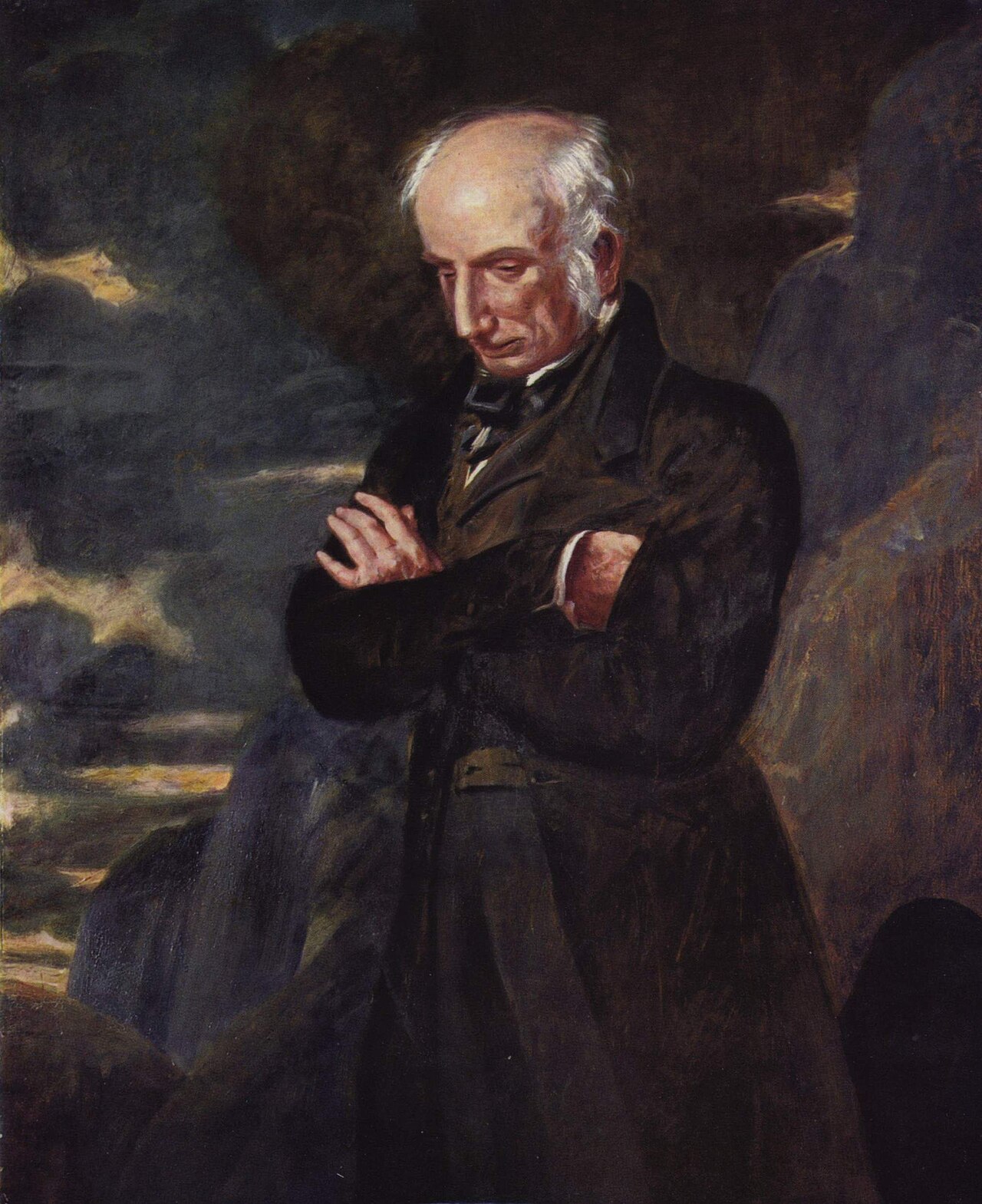
The Romantic period began in the late 18th century as a response to the social and political norms of the Age of Enlightenment and as a reaction to the Industrial Revolution. The period brought profound change to the European world through literature, arts, and thought. Prominent English poets like William Wordsworth, Samuel Coleridge, William Blake, and John Keats appropriated poetry as the highest form of art and contributed to the Romantic movement through their writings. Their work shares mutual values, such as the emphasis on emotion and the exaltation of nature. For Wordsworth in particular, nature “was a saving process and a benign Presence” (Bloom and Trilling 7). This outlook on nature coined him the nickname of the “nature poet”.
William Wordsworth, the “nature poet”. Credit: National Portrait Gallery
Firstly, Chris uses nature to connect with Bessie’s beauty and love tangibly. He sees nature as a relatable concept for making comparisons as it always surrounds us. In a letter written in June 1944, Chris uses figurative language to describe her letters. He says that “these letters of yours are just like an English river running through green fields, clear, refreshing, bright, confident. You come rippling down at me, surround me with your beauty and your meaning…” (64). Just like the English river that gives life as it flows through the pastoral landscape, Bessie rejuvenates Chris with love through nature’s beauty and her correspondences. He yearns to be enveloped by her natural presence and uses nature metaphors to substitute her void. We see another example of figurative language in a May 1944 letter, where Chris desires to see Bessie “…in puris naturalibus…to forage around you, to rove over you, to subdue due you, to possess you” (57). Chris uses language of natural possession such as ‘forage’ to secure his love for her in his war-torn environment.
Like Chris’ comparison of Bessie to nature’s beauty, William Wordsworth writes in his Preface to Lyrical Ballads that “he considers man and nature as essentially adapted to each other, and the mind of man as naturally the mirror of the fairest and most interesting qualities of nature” (Reidhead and Johnson 301). He argues that human beings and the natural world are not separate. We are a part of it, and it is a part of us. It is through this connection to nature that Chris’ love for Bessie transcends borders and oceans regardless of their locale’s geography. In Chris’ eyes, the love he finds in Bessie’s letters is the missing puzzle piece that makes living sustainable.
Through this connection with nature, Chris begins to imagine an alternative reality where he begins to subject himself to Bessie. Chris almost wants to fall slave to her. In a letter composed in April 1944, Chris states, “I am your servant and your master at once” (46). Perhaps this means that as a master he is taking charge of their love story but as a servant to Bessie, he views her as a force of nature rather than an object. The power and force Bessie emits from these letters blind Chris from the surrounding environment and bind him to her love. He longs to be consumed by her love letters. Like Chris, Wordsworth views nature as a power and not an object. He believes that nature “shaped his powers of mind and supplied his life” (Blunden 74). Chris continues writing to Bessie stating, “I will command you and be commanded by you”, reaffirming his desire to control the narrative with a different storyline as well as his subservience to her (47). Seeing Bessie this way provides Chris with a sense of grace and responsibility; it is dependent upon him to write so she will respond and comfort.
Chris also uses his imagination as a mode of escapism. This distracts him from the present and offers opportunities to question the future. We see this in a letter from April 1944 where he writes, “…tell me of your clothes. Tell me your room, the furniture, so that I can better imagine you, more easily come to you when you are alone” (52). Asking these questions anchors Chris to a possible reality when there is no war, and he is reunited with Bessie. He demands every possible detail to attain a well-rounded image of his future wife. Similarly, Wordsworth epitomizes this escapist behavior. He would often depart commercialized areas overtaken by the Industrial Revolution for the Lake District to “relieve himself, not so much of himself, as of those exterior circumstances which aggravate and disturb him” (Jochem 18). Surrounding himself in nature would cure his personal struggles and allow him to be closer to his true love: nature. Furthermore, Bessie’s letters aid Chris in envisioning a better future and her descriptions construct a direct portal to her heart.
Chris also uses nature as imagination to deem his relationship with Bessie as fantastical. He tries to cope with his love pragmatically by writing poetic letters but resorts to writing sexually explicit letters. This propels his imagination and fantasies to bloom. In a letter written in March 1944, he describes his fantasies saying, “This is a fever that I have which makes me hot and dispossesses my mental faculties whenever I think of you, which is more and more often” (32). One month later he writes, “how impossible to sleep with thought and wonder of you hot within me” (41)! Whenever Chris thinks of her, he is overcome by an “irrational, illogical, nonsensical” love fever where he places Bessie on a pedestal, just as Wordsworth elevates nature (32). Moreover, Wordsworth characterizes poetry in his Preface to Lyrical Ballads as “the spontaneous overflow of powerful feelings”, comparing love to the natural fantasy of life (303). With every passing letter that he writes, Chris’ fantasy world expands. He begins to lust over her femininity and becomes infatuated with her body. Responding to these feelings, he writes, “as I toss and turn and wriggle and writhe I think of you, probably doing the same…I know that if I think of you, I will not sleep; yet I keep on thinking of you, and get hotter and hotter” (41). Chris’ dreamlike hallucinations show us his love for Bessie is fantastical. Because of the war, his hormones are bottled up and these letters give him a fantastical outlet to release. Writing letters to Bessie where Chris describes her image, releases his sexual desires, fueling his connection with her.
These examples teach us that Chris uses nature through the Romantic ideas of William Wordsworth to equate his love for Bessie. We learn that Chris uses nature to connect with Bessie’s beauty. He uses figurative language to take the place of void and language of natural possession to secure his love for her. Additionally, Wordsworth argues that human beings and the natural world are not separate. Through this connection with nature, we learn that Chris uses his imagination three separate ways. Firstly, he creates an alternative reality where he subjects himself to Bessie. He views her as not an object but a power, which she releases from her letters to secure Chris. Bessie’s letters give Chris a sense of grace. Wordsworth agrees with this idea and believes the power of nature gave him intellect. Secondly, Chris uses imagination as a mode of escapism to distract himself from the present so he can ponder his future. He sends letters demanding her every detail to attain a clear image of his future wife. The details he receives in her letters aid Chris in visualizing a different future. Lastly, Chris uses imagination to create a fantastical relationship with Bessie. He places her on a pedestal in response to the love fever he gets when thinking of her. In comparison, Wordsworth likens love to the natural fantasy of life. Moreover, letters describing Bessie’s image give Chris comfort and propel him to lust over her and release his sexual desires.
This past week we completed our study unit on World War II letter writing with our presentations which accompany our papers. It was very interesting to listen to many of the presentations and take note of the various public speaking techniques that were being used. I was especially impressed with the visual aids incorporated into the presentations and how each aesthetic differed from the next. One such presentation I found compelling addressed the theme of hope in letters from the “Last Letters from the Holocaust” archive in Yad Vashem. The individual spoke about that even in times darkness and destruction, hope always finds its way to the surface. Torah and Talmudic scholarship were used to support the argument and it was interesting to see which individuals were used to support the different strings of reasoning. I was surprised that the presenter volunteered to go first as she was struggling to brainstorm ideas. That being said, she did a great job.
Next up…Ezra!
When I was called up to present, I was very nervous. I am still not done with my paper and not having all of the necessary points to defend my argument about elements of romanticism in the My Dear Bessie Letters scared me. Overall, I think I presented pretty well considering the limited time I had to prepare due to Jewish holidays. I knew that it would be more interesting if the audience was involved and thank goodness there was participation. Making use of my surrounding space was very important to me and I used it when talking about the word “forage.” The laughter I received in response to my doing that was satisfying. I initially was very nervous about the time constraint in my presentation but after I finished, I was pleasantly surprised. Ironically, I wish I had a little bit more time to talk about my last point which would have tied the presentation together.
Hearing that we have extended time to complete our papers was the highlight of my day. Even though I will continue to spend much time writing and editing, I find comfort in knowing that I don’t have to be so stressed out about the impending deadline. Stay tuned next week to read my paper!
This past week in class, all of us were surprised to see that Tina wasn’t standing behind the podium but Annalise instead. Annalise gave an informative and compelling presentation about the use of a thesis. A thesis is used to drive the point you are trying to convey. It is the crux and foundation of your argument. In doing so, it should clearly and explicitly define your claim or question. Additionally, the thesis is used as a tool to format the rest of the paper. Once the thesis is written, you are able to write your argument.
As a thoughtful writer who is very calculating when it comes to word choice, Annalise gave some very helpful suggestions and techniques for developing a thesis statement. The first technique she gave was creating a mind map. By doing this, it gives us an easier way to view how we want to branch out our argument through our topic. The next suggestion Annalise gave was to talk out our ideas. She gave numerous examples like our friends, family, roommate, and enemy, just to name a few. Talking it out assists in finding the root of your argument. It is also helpful to hear feedback from peers about your ideas and know if your argument is valid and legitimate. The last suggestion Annalise gave was to write and then summarize it with the use of a few keywords just like we do with these blog posts. I really connected with this suggestion because I am often confused with what my own topic is. Writing is scary, and Annalise’s suggestion about facing it head-on and then writing keywords seemed like a creative solution and different approach.